Military ranks of the six services, E-1 to O-10
Independent site, not affiliated with the Department of War, any military service or DFAS.
Pick a service and a pay grade: the rank title, its insignia, what it is called in the other five services and its 2026 basic pay at your years of service.
Find a rank: title, insignia, equivalents and pay
Army, E-5 · Enlisted
Sergeant (SGT)
Noncommissioned officer
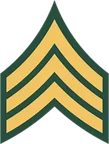
| Marine Corps | Sergeant (Sgt) |
| Navy | Petty Officer Second Class (PO2) |
| Air Force | Staff Sergeant (SSgt) |
| Space Force | Sergeant (Sgt) |
| Coast Guard | Petty Officer Second Class (PO2) |
| 2026 basic pay, over 4 years | $3,946.80 a month |
Same pay grade means the same basic pay in every service. Basic pay only: housing, food and special pays are not included.
Everything about E-5The six US armed services share one ladder of pay grades and give each step their own rank titles. Enlisted members run from E-1 to E-9, warrant officers from W-1 to W-5, and commissioned officers from O-1 to O-10, with a five-star level above it reserved for wartime. The Department of War chart insists on the difference: pay grades "are administrative classifications used primarily to standardize compensation across the military services", while rank is "a badge of leadership". A grade can carry two ranks, such as specialist and corporal at Army E-4, and between services rank follows the grade, so an Army staff sergeant, a Marine staff sergeant and a Navy petty officer first class are all E-6. Counting each title shown on the chart, the services have Army 28, Marine Corps 27, Navy 26, Air Force 24, Space Force 20, Coast Guard 24. In 2026 basic pay runs from $2,225.70 a month for a new E-1 to $18,999.90 for a general or admiral, the same in every service. The lookup above gives the title, insignia and pay of any grade.
Chart and pay tables read on · Radif Partners · How the data is read · About this site
Pay grades first, titles second
Title 37 of the United States Code lists the pay grades of the uniformed services in section 201: E-1 to E-9 for enlisted members, W-1 to W-5 for warrant officers and O-1 to O-10 for commissioned officers. The letter gives the category and the number the step: E-1 is the most junior enlisted grade, O-10 the four-star general or admiral. Every service uses the same grades and the same pay tables, which is why they are the common language between branches. A Marine who reads that a sailor is an E-6 knows at once that the sailor sits at the level of a Marine staff sergeant, whatever the sailor's title.
Titles, by contrast, belong to each service. The Army and the Marine Corps call their E-5 a sergeant, the Air Force a staff sergeant, the Navy and the Coast Guard a petty officer second class. Some grades carry two titles in the same service: the Army has specialists and corporals at E-4, the Marine Corps master gunnery sergeants and sergeants major at E-9. In that case the two receive the same pay, but one ranks above the other inside the service. The Department of War chart notes that "among the services, however, rank and precedence are determined by pay grade". The grid below gives the Army and Navy titles of each grade; each grade opens its own page with the six services side by side.
Enlisted ranks, E-1 to E-9
Most members of the armed forces are enlisted. The chart describes three stages. Members in grades E-1 to E-3 "are usually either in some kind of training status or on their initial assignment": basic training, then a specialty called a military occupational specialty in the Army and the Marine Corps, a rate in the Navy and an Air Force specialty in the Air Force. The midlevel grades bring formal leadership through the titles noncommissioned officer and petty officer: an Army sergeant, an Air Force staff sergeant and a Marine corporal are NCOs, and the Navy reaches petty officer at third class, E-4. At E-8 and E-9 members have, in the chart's words, "15 to 30 years on the job, and are commanders' senior advisers for enlisted matters".
Each service has its own logic. The Army runs private, private, private first class, then specialist or corporal at E-4 and a ladder of sergeants up to sergeant major. The Marine Corps names its E-1 private and its E-2 private first class, then lance corporal and corporal before its sergeants. The Navy and the Coast Guard climb from seaman recruit through petty officer to master chief petty officer, and the Coast Guard wears the Navy's insignia in another color, except at seaman recruit, which has one stripe. The Air Force starts with airman basic and airman first class; the Space Force uses specialist titles, specialist 1 to specialist 4, below its sergeants. The enlisted ranks page compares the six ladders, and the NCO page explains where each service starts its noncommissioned officers.
What is this rank called in another service?
Army Staff Sergeant (SSG) in the Navy
Petty Officer First Class
| Pay grade | E-6 |
| Group | Petty officer |
| Abbreviation | PO1 |
Equivalence follows the pay grade, the rule the services use between them.
Warrant officers, W-1 to W-5
Warrant officers are technical specialists. The chart explains that they "hold warrants from their service secretary", that the lowest-ranking serve under that warrant but "receive commissions from the president upon promotion to chief warrant officer 2", and that they remain specialists where commissioned officers are generalists. The Army, the Marine Corps and the Navy use all five grades, from warrant officer 1 to chief warrant officer 5. The Coast Guard has chief warrant officers 2 to 4. The Space Force has none.
The Air Force is the change the chart has not caught up with. It still says that there are no warrant officers in the Air Force, but the service had reintroduced the corps by 2024: on December 6, 2024, the first 30 Air Force warrant officers graduated from its Warrant Officer Training School, for cyber, intelligence and space duties, after a gap since 1959. Their titles and insignia do not appear on the chart we read, so this site shows the grades without inventing them. The warrant officer page gives the five grades service by service.
Commissioned officers, O-1 to O-10
Commissioned officers "hold presidential commissions and are confirmed at their ranks by the Senate". The Army, the Air Force and the Marine Corps group them as company grade officers from O-1 to O-3, field grade officers from O-4 to O-6 and general officers from O-7 up; the Navy speaks of junior grade, mid-grade and flag officers. The Army, Marine Corps, Air Force and Space Force share the titles: second lieutenant, first lieutenant, captain, major, lieutenant colonel, colonel, then brigadier general to general. The Navy and the Coast Guard run from ensign through lieutenant junior grade, lieutenant, lieutenant commander, commander and captain to rear admiral lower half, rear admiral, vice admiral and admiral.
One title therefore means two different grades: a captain is an O-3 in the Army and an O-6 in the Navy. That is the most common confusion between the services, and the reason the lookup above always shows the pay grade with the title. Above O-10 the chart places General of the Army, Fleet Admiral and General of the Air Force, each "reserved for wartime only"; the five-star page names the officers who held them. The officer ranks page sets the six ladders side by side.
How is this rank abbreviated?
Navy, O-3
LT
| Lieutenant | LT |
Abbreviations as printed on the Department of War chart; capitals differ by service.
Insignia
Rank insignia follow a few families. Enlisted members wear chevrons, with rockers below and arcs or stripes added as they rise, and the Navy and Coast Guard add an eagle and a specialty mark on their rating badges; the chart notes that gold stripes indicate 12 or more years of good conduct. Officers wear bars, oak leaves, eagles and stars: one gold bar for a second lieutenant or ensign, one silver bar for a first lieutenant, two silver bars for a captain or Navy lieutenant, a gold oak leaf at O-4 and a silver oak leaf at O-5, an eagle at O-6, then one star per grade from O-7 to O-10. Naval officers also wear sleeve stripes or shoulder boards depending on the uniform. The site shows 133 insignia images taken from the Department of War chart, a work of the federal government, and its insignia quiz tests them one by one.
Equivalent ranks between services
Equivalence follows the pay grade, and nothing else. A Navy chief petty officer, an Army sergeant first class, a Marine gunnery sergeant and an Air Force master sergeant are all E-7, earn the same basic pay at the same length of service and rank equally between services. Titles that look alike can mislead: an Air Force staff sergeant is E-5, a Marine staff sergeant E-6. The equivalents chart lines up every grade of the six services, and the abbreviations page explains why the same rank is SSG in the Army and SSgt in the Marine Corps.
Basic pay in 2026
Basic pay rose by 3.8% on January 1, 2026, the increase given by the formula of 37 U.S.C. 1009, which follows the Employment Cost Index. The Defense Finance and Accounting Service publishes three monthly tables, for enlisted members, warrant officers and commissioned officers, each by grade and cumulative years of service, from "2 or less" to "over 40". A private with more than four months earns $2,407.20 a month, a sergeant at E-5 over four years $3,946.80, a new second lieutenant or ensign $4,150.20. Officer rates are capped at $15,408.30 for O-6 and below and $18,999.90 for O-7 to O-10, the levels V and II of the Executive Schedule; the six service senior enlisted leaders and two senior enlisted advisors receive $11,166.90 whatever their years of service.
Basic pay is only part of military compensation. The Congressional Research Service puts it at about three-fifths of regular military compensation, the rest being the tax-free housing and food allowances and the tax advantage they carry. Those allowances depend on location and family, so this site does not estimate them. The 2026 pay chart gives every rate with a calculator, and the pay grades page explains how the tables are read.
Quick check: 2026 basic pay
E-4, over 2 years
$3,303.00 / mo
| Over a year | $39,636 |
| Lowest rate of the grade | $3,142.20 |
| Highest rate of the grade | $3,815.40 |
DFAS table effective January 1, 2026; basic pay only.
The 2027 raise is not settled
No 2027 table exists yet. The statutory formula gives 3.6% on January 1, 2027, and the Senate Armed Services Committee bill keeps that figure. The President's budget and the House bill instead propose 7% for E-1 to E-5, 6% for E-6 to O-3 and 5% for O-4 and above, according to the Congressional Research Service. The raise becomes final with the National Defense Authorization Act, or by the formula if Congress sets no other figure. Until then, every 2027 amount on this site is labeled an estimate, and the 2027 raise page follows the bills. The history of raises since 2004 shows how often Congress has departed from the formula.
Every page of the site
Ranks by service
- Rank equivalentsOne table, six services: the rank each service gives to every pay grade from E-1 to O-10.
- Army ranksPrivate to General: the insignia, abbreviations, unit sizes and 2026 pay of every Army rank.
- Marine Corps ranksPrivate to General: LCpl, Cpl, GySgt, MGySgt, warrant officers and officers, with insignia and pay.
- Navy ranksSeaman Recruit to Admiral: petty officers, chiefs, Navy captain versus Army captain, insignia and pay.
- Air Force ranksAirman Basic to General: SrA, SSgt, TSgt, MSgt, CMSgt, the new warrant officers, insignia and pay.
- Space Force ranksSpecialist 1 to General: Spc1-Spc4, Sgt, TSgt, MSgt, CMSgt and officers, with insignia and pay.
- Coast Guard ranksSeaman Recruit to Admiral: Navy titles, Coast Guard insignia, warrant officers W-2 to W-4, pay.
Pay grades
- Enlisted ranksE-1 to E-9 in the six services: junior enlisted, NCOs and petty officers, senior NCOs and chiefs.
- NCO ranksNoncommissioned officers and petty officers: where each service starts them, and what they lead.
- Warrant officer ranksW-1 to W-5: who has warrant officers, appointed or commissioned, insignia and the 2026 warrant pay table.
- Senior enlisted leadersSMA, SgtMajMC, MCPON, CMSAF, CMSSF, MCPOCG and the SEAC: the one-person E-9 posts and their flat pay.
- Officer ranksO-1 to O-10: company and field grade, generals and admirals, two naming systems and the 2026 pay cap.
- Five-star ranksGeneral of the Army, Fleet Admiral, General of the Air Force: wartime-only ranks above O-10, and who held them.
- E-1Private, Seaman Recruit, Airman Basic, Specialist 1: the entry grade, its two pay rates and why it has no insignia.
- E-2PV2, Private First Class (Marines), Seaman Apprentice, Airman, Specialist 2: the first stripe and one flat rate.
- E-3PFC, Lance Corporal, Seaman, Airman First Class, Specialist 3: insignia and the three 2026 rates.
- E-4Specialist and Corporal (Army), Corporal (Marines), Petty Officer Third Class, Senior Airman, Specialist 4.
- E-5Sergeant (Army, Marines, Space Force), Staff Sergeant (Air Force), Petty Officer Second Class.
- E-6Staff Sergeant (Army, Marines), Petty Officer First Class, Technical Sergeant (Air Force, Space Force).
- E-7Sergeant First Class, Gunnery Sergeant, Chief Petty Officer, Master Sergeant, and the Air Force first sergeant.
- E-8Master Sergeant and First Sergeant (Army, Marines), Senior Chief Petty Officer, Senior Master Sergeant.
- E-9Sergeant Major, Master Gunnery Sergeant, Master Chief, Chief Master Sergeant, and each service's top enlisted leader.
- W-1Warrant Officer 1 in the Army (WO1), Marine Corps (WO) and Navy: appointed by warrant, paid from the W table.
- W-2Chief Warrant Officer 2: CW2 in the Army, CWO2 in the Marine Corps, Navy and Coast Guard; the first commissioned warrant grade.
- W-3Chief Warrant Officer 3 (CW3 in the Army, CWO3 elsewhere): insignia and the 2026 pay row.
- W-4Chief Warrant Officer 4: senior-level experts, top warrant grade of the Coast Guard.
- W-5Chief Warrant Officer 5: master-level experts; no W-5 rate before twenty years of service.
- O-1Second Lieutenant (2LT, 2ndLt, 2d Lt) and Ensign (ENS): the gold bar and the 2026 pay row.
- O-2First Lieutenant and Lieutenant Junior Grade (LTJG): the silver bar and the 2026 rates.
- O-3Captain (Army, Marines, Air Force, Space Force) and Navy or Coast Guard Lieutenant: the two silver bars.
- O-4Major (MAJ, Maj) and Lieutenant Commander (LCDR): the gold oak leaf and the 2026 rates.
- O-5Lieutenant Colonel and Navy Commander (CDR): silver oak leaf, battalion command and 2026 pay.
- O-6Colonel and Navy or Coast Guard Captain (CAPT): the eagle insignia and the capped 2026 rate.
- O-7Brigadier General and Rear Admiral Lower Half (RDML): one star, capped pay.
- O-8Major General and Rear Admiral Upper Half (RADM): two stars, division command, pay at the cap.
- O-9Lieutenant General and Vice Admiral (VADM): three stars, capped pay from twenty years.
- O-10General and Admiral (ADM): four stars, service chiefs and combatant commanders, pay at the cap.
Military pay
- Pay grades explainedE, W and O: what a pay grade is, how it differs from a rank, and why it sets pay in every service.
- 2026 pay chartEvery 2026 basic pay rate, E-1 to O-10, by years of service, with the calculator and the DFAS notes.
- 2027 pay raise3.6% or 7-6-5? Where the 2027 military pay raise stands, and an estimate for your grade.
- Pay raise historyEvery January raise in basic pay since 2004, against the ECI formula, with the targeted increases.
Guides
- Rank insignia and quizChevrons, rockers, bars, leaves, eagles and stars: how to read an insignia, with a quiz on all six services.
- Rank abbreviationsSSG or SSgt, 2LT or 2d Lt, CW2 or CWO2: every abbreviation of the six services, and why they differ.
- Army unit sizesTeam, squad, platoon, company, battalion, brigade, division, corps: size and the rank that leads each.
What the site does not do
It does not recruit, and it does not speak for any service. It gives basic pay only, not housing, special pays, bonuses or retirement, and it does not predict promotions: the time-in-grade figures it quotes are the Army's own minimums, not a forecast. Where an official source is silent or out of date, as with Air Force warrant officer titles, the page says so rather than filling the gap.
How this site works
Rank titles, abbreviations and insignia come from the Department of War rank chart, Army descriptions and unit sizes from army.mil, pay from the DFAS tables effective January 1, 2026, and the history and the 2027 proposals from the Congressional Research Service. The .mil sites often refuse automated reading, so some pages were read through dated copies of the Internet Archive; each figure links to the official page it comes from. The method page describes each step and its limits.
Sources
The rules and dates quoted here were read on these official pages on November 1, 2026.
- Department of War: U.S. Military Rank Insignia, enlisted, warrant officer and officer charts for the six services
- U.S. Army: Army ranks, enlisted, warrant officer and officer, with unit sizes
- U.S. Air Force, December 6, 2024: First Air Force warrant officers graduate, prepare to enter force
- DFAS: Basic pay, enlisted, effective January 1, 2026 (page updated January 12, 2026)
- DFAS: Basic pay, warrant officers, effective January 1, 2026 (page updated January 15, 2026)
- DFAS: Basic pay, commissioned officers, effective January 1, 2026 (page updated February 13, 2026)
- 37 U.S.C. 201: Pay grades, assignment to; general rules (US Code, 2024 edition, govinfo)
- 37 U.S.C. 1009: Adjustments of monthly basic pay (US Code, 2024 edition, govinfo)
- Congressional Research Service, IF10260: Defense Primer, Military Pay Raise (updated January 26, 2026)
- Congressional Research Service, IN12706: FY2027 NDAA, Military Basic Pay Raise Proposal (July 14, 2026)
Questions people ask
What is the difference between a rank and a pay grade?
The pay grade, such as E-4 or O-3, is an administrative level that sets basic pay and is the same in every service. The rank is the title worn at that grade, such as corporal or lieutenant. One grade can carry two ranks: the Army has both specialist and corporal at E-4.
Which military rank is the highest today?
Four-star general or admiral, pay grade O-10. The five-star ranks above it, General of the Army, Fleet Admiral and General of the Air Force, are reserved for wartime and have not been held since the World War II generation, according to the Army.
How much does a new recruit earn in 2026?
An E-1 earns $2,225.70 a month of basic pay during the first four months of active duty, then $2,407.20, under the DFAS table effective January 1, 2026. Housing and food allowances are paid on top where they apply, and the rate rises with promotion to E-2.
Has the 2027 military pay raise been decided?
Not on November 1, 2026. The House bill carries a raise of 7%, 6% or 5% depending on the grade, the Senate committee bill 3.6% for all. The final figure comes with the National Defense Authorization Act, and DFAS publishes the new tables once it is set.
Do all six services use the same pay tables?
Yes. Basic pay depends on the pay grade and the years of service, not on the service: an Army sergeant and a Navy petty officer second class, both E-5, earn the same rate. The Coast Guard, part of the Department of Homeland Security in peacetime, uses the same tables.
Is this site run by the military or a recruiter?
No. It is an independent reference published by Radif Partners, with no tie to the Department of War, any service, DFAS or a recruiting office. It links to the official pages it reads, dates each figure, and keeps nothing you enter in the tools.
Written by Radif Partners
Independent publisher of a rank, insignia and basic pay reference for the six US armed forces, built on the Department of War rank chart and the DFAS pay tables
Ranks and pay tables checked on · Editorial policy · Contact
Military ranks and basic pay 2026, read on the Department of War chart and the DFAS tables, last checked on